1. The Liturgy: The Song of Lost Carcosa
The foundational text of the religion is found written in a cipher room placed right above a door that D3rlord3 mines through. After decoding the block of text, it reveals the chilling, rhythmic hymn of the cult. This is the exact liturgy the believers used to honor their god’s domain:
“Along the shore the cloud waves break, The twin suns sink behind the lake, The shadows lengthen in Carcosa.
Strange is the night where black stars rise, And strange moons circle through the skies, But stranger still is Lost Carcosa.
Songs that the Hyades shall sing, Where flap the tatters of the King, Must die unheard in Dim Carcosa.
Song of my soul, my voice is dead, Die thou, unsung, as tears unshed Shall dry and die in Lost Carcosa.”
This text serves as the first act of an overarching curse. For the believers, Carcosa isn’t a physical place you can walk to; it is a broken reality characterized by “twin suns” and “black stars” that begins to bleed into the player’s world once they interact with it. The line “Where flap the tatters of the King” describes the physical manifestation of their god—a decaying, cosmic entity wrapped in frayed yellow robes. The liturgy emphasizes that acknowledging the King strips a believer of their autonomy: “my voice is dead.”
2. The Books Under the Village: The Madness of the Devotees
When D3rlord3 uncovers the abandoned cult village, he finds the true horror of the religion documented in a hidden Book and Quill tucked beneath the floorboards of a structure.
Unlike official church prayers, this diary was written by an actual inhabitant of the civilization as it was actively collapsing into cosmic madness. The believer writes a scathing, terrified, yet deeply submissive account of what the religion is doing to their community:
“People are insufferable… ‘The King is coming,’ my ass. If anything, I wager that their King is already here.”
The text then takes a horrifying, meta-fictional turn as the writer realizes they are being watched by the very concept they are writing about:
“…It’s watching me write this.”
This quote highlights the mechanism of the religion’s “infection.” The entity does not require a physical portal to invade a world. The moment a civilization or a player (like D3rlord3 or Avery) becomes aware of the King, the King becomes aware of them. The believer’s writing transitions from skepticism to immediate paranoia, proving that the dogma of the cult is actively forced into the minds of anyone who tries to document it. The yellow carpets and yellow blocks scattered through the village are physical representations of this madness seeping into the geometry of the game.
3. The Paradox of Knowledge: D3rlord3’s Warning Cipher
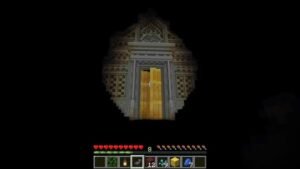
The final, most profound “scripture” of the religion isn’t written by an ancient cultist, but by D3rlord3 himself after he is forced to look behind the censored castle door.
Looking past the door is equivalent to witnessing the “Second Act” of the King’s play. It gives the victim absolute cosmic revelation, fracturing their perception of time. Because the King sees the past, present, and future simultaneously, D3rlord3 is cursed with that same foresight. Knowing he is trapped, he uses a string of numbers at the end of his recording to leave a desperate, looping commandment for the next victim (Avery):
“Whatever you do, at the crossroads, don’t turn left. Don’t be fooled. It’s listening. You can’t outsmart it. It’s listening to me. It’s watching me. It isn’t from this world… At the crossroads, don’t turn left.”